Space Empires作者访谈
Jim Krohn and Space Empires
Galactic empire games are one genre that I am always interested in checking out, so when GMT placed Space Empires on its pre–order list I was intrigued enough to contact designer Jim Krohn. He soon granted me an e–mail interview.
Kris: So why design Space Empires? What will this game have that will distinguish it from all the other space opera games?
Jim: I did not set out to design a game for publication. I designed it because I enjoyed the genre. There is a lot that I think this game has that really sets it apart.
It is very playable. I have a diverse interest. I enjoy many wargames and eurogames covering just about everything. I wanted a game that had all the sci–fi elements that I wanted, but one that I also could pick up very quickly and play in a night. Over the years I eventually came up with solutions that kept things like carriers, cloaking, mines, technology advancement, etc. in the game, but kept the rules very simple and intuitive. Once you play through the game once, you pretty much won't have to go to the rule book.
I also wanted a game that had a balance between conflict, technology, and economics. Some games may emphasize one of those elements. In Space Empires, all three are important. You have to have good economics and you have to have good technology, but the whole point of the game is the conflict. If you ignore your fleet and the position on the board, you will get schooled very quickly. I've often said that this is not a game where you build your empire just so that you can feel good about your achievement. You build your empire so that you can crush your enemies underfoot. In that sense, it has a lot in common with the Space Empires computer game.
This leads to a lot of tough decisions that have to be made almost every turn.
To do all that and keep it simple and short – I'm really pleased with how it came out.
Kris: The blurb for the game on the GMT website says the game has been in development for twenty years. Can you give me a little history of how the game came to be and what has changed over the years?
Jim: In 1990 I helped design a truly epic space game with a friend of mine. It had a huge tech tree, it had boxes on the outside of the map to represent each planet, we used risk pieces to track population on each planet, huge exploration tables, when we designed a ship we wrote the values on a hand–made counter, we kept the map on a metal tray used to store blueprints and all the task force markers were glued on magnetic strips.....and it took about 25–30 hours to play one game. Then I had kids. :–)
A few years later, the desire to play a similar game came back, but a complete remake was needed. I started from scratch and tried to redesign each element in such a way that I could keep it in, but it would be simpler and quicker. For example, complicated exploration charts were replaced by a smaller hex grid with an exploration counter in each hex. Exploration is as simple as flipping the counter. Technology was simplified so that separate weapon charts were not needed. Instead, most technology modifies the strengths shown on the ship counter. Task force markers with a separate display were replaced by counters. The counters are hidden until in combat and the fog of war is further maintained by decoy counters and numbers under the counters to indicate how many ships are represented by the counter. How cloaking was handled, how mines were handled, etc. all changed. It kept on being improved over the many redesigns through the years.
All of this greatly speeded up play, but kept the same flavor and decision making.
Kris: Let's talk about the board. Will there be "terrain" in every hex or will the majority of your galaxy be empty space (as is the case in real life)?
Jim: Each map hex represents a vast amount of space and the exploration counter in each hex represents the major terrain feature in that space. However, some of the "terrain" is non–persistent. The exploration counter can represent something dangerous or an event that happens during exploration and is removed after being flipped. Some counters represent a mineral resource that can be mined. Once mined, the counter is removed. The net effect is that by the mid point of the game about half the hexes will be empty and the other half will have a colonizable planet, nebula, asteroid, warp point, or something else that has an impact in game terms.
Kris: In these kind of Civ–building games, I seem to love the economics and technology research the most. What kind of mechanics does Space Empires have for these subjects?
Jim: ECONOMICS: There are three ways to get resources in the game. The first is by colonizing planets. This is expensive and yields long term results. The second is by mining the mineral I mentioned earlier. This yields a quick influx of cash, but no long term benefit. The third is through trade by connecting planets with your Merchant Ship Pipelines. You need to use all three.
TECHNOLOGY: Technology is one of the things that makes the game awesome. As far as warships go, at the start you are only able to build scouts. You have to research larger ship hulls to build bigger ships – destroyer, cruiser, battlecruiser, battleship, and dreadnaught. Each ship type comes with basic stats for attack, defense, and how much damage they can take. You can also research improvements in attack and defense technology in order to modify (increase) those stats on your ships. Researching movement technology increases your speed, tactics technology can effect who gets to shoot first, cloaking, carriers, and mines all add new ship classes. Scanners, point defense, and mine sweepers provide some means of combating them. Terraforming is needed to settle on barren worlds, Space Yard technology is critical to be able to produce more ships at key locations, and exploration technology will greatly help exploration, especially in deep space.
Kris: Can you tell me more about Merchant Ship Pipelines and Terraforming? What are pipelines? How much detail is there in terraforming?
Jim: Merchant Ship Pipelines: There is a class of ship in the game referred to as MS (Merchant Ship) Pipelines. When built and deployed, the counter represents groups of slow moving merchant ships as well as navigational beacons and portions of space that have been charted and cleared for space travel. They always move very slowly (speed of 1 regardless of technology level), they are useless and vulnerable in combat, and they have to be deployed to be effective. Unlike warships which show a generic picture on their back (in order to hide what is represented by the counter until it has been engaged in combat for the first time), MS Pipelines have an active and an inactive side. On a turn that they do not move they can be flipped to their active side. They give you two benefits.
The first benefit is trade income. Every planet which is connected to your home planet by a string of MS Pipelines produces one extra income. This can be an important part of your income that can be disrupted by raiding fleets, cloaked or not. You have to maintain rear area security.
The second benefit is movement. A ship that spends its entire turn travelling along MS Pipelines can move one extra hex. This is even more powerful when facing difficult portions of space. Nebulas and asteroids significantly slow movement, but active MS Pipelines remove that restriction. Black holes can be very dangerous to your ships, but if you can successfully get an MS Pipeline set up in a black hole hex (without getting destroyed) then it allows your other ships to ignore the black hole.
Terraforming: Some planets in the game are labeled "Barren", including all planets with non–player aliens. These cannot be settled until you have researched terraforming. You would think that it would be a no brainer and that you would always want to purchase that technology, but the game keeps enough pressure on you in other areas that you don't always research terra–forming. In can become a very big decision in the game.
Kris: Do the players represent various alien races or competing branches of the human race?
Jim: The players are different alien races all setting out from their homeworlds to expand their empire and look for trouble.
Kris: From what I have read, the combat in Space Empires seems to be a little more involved than combat in some of the current space opera games. How does combat work?
Jim: Ships on each side are organized by effective firing range – battleships get to fire before scouts, for example. If there is a tie, it is resolved by the tactics rating. When it is their turn, each ship picks a target and fires. The ship's attack technology is added to its attack strength. From that number you subtract the target ship's defense technology and defense strength. The resulting number is what you need to roll or lower on a ten sided die in order to get a hit (no combat charts – it is very simple in practice). Of course, this is modified by some other technologies and some of the "terrain" in the hex. There is also a bonus to your ships' attack if you have twice as many ships as your opponent, regardless of ship size (representing that with more ships it is easier to maneuver to fire on downed shields or weak spots). Many ships take more than one hit to kill it. Ships can be screened out of combat and of course you can retreat.
This makes the combat pretty thematic and most times very tense. However, it is also very simple and quick – you probably have noticed that this is a recurring theme with me. A 4X space game can easily get massively long and complicated. In a sense I wanted to have my cake and eat it too. I wanted all the cool 4X stuff, but I wanted it playable and quicker. I had to constantly work in that direction during the design in order to make it happen.
Kris: What is the sequence of a typical turn?
Jim: Each player moves, resolves any combat, and completes exploration. This cycle repeats three times and then everyone completes an economic phase. During the economic phase you collect income, pay maintenance, do research, build ships, and grow your colonies.
Kris: How many players can play the game?
Jim: 2–4 players. The game will come with two different maps to aid in set up (a two player map and a multiplayer map).
Kris: If the game is a success, is there room for an expansion (more players, more technologies)?
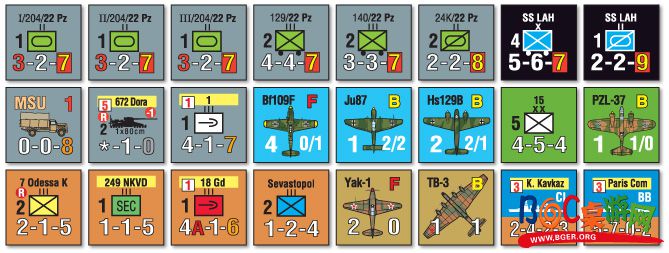
Jim: Sure, absolutely. There is a lot in this game, however. GMT really gave the game wings in that they were willing to include so much in the base game. It comes with over 700 counters and 18 different ship types/classes. Obviously, these are not used all at the same time. This is not a monster game, but all the counters are needed in order to accommodate all the cool stuff for the four different players. In this game it is almost like you are really getting the base game, plus the first expansion.
Kris: Thanks for the interview.
|


 发表于 2010-10-1 13:58:35|

 收藏
 顶