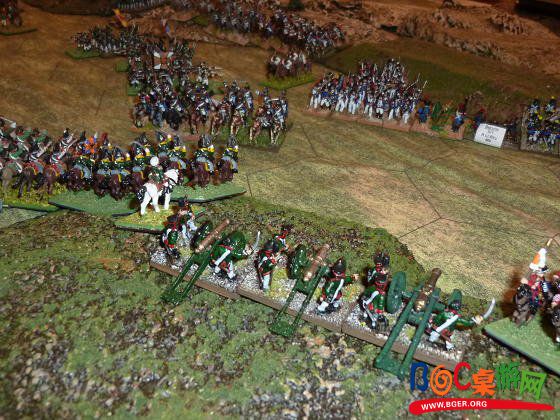
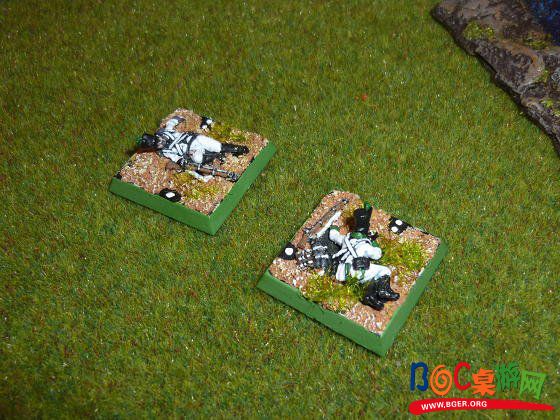
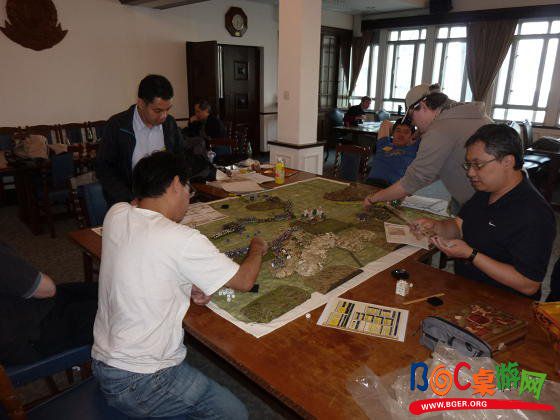
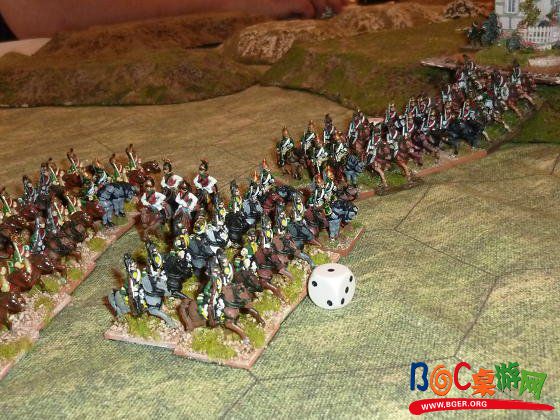
Napoleon's Battles
A Brief Introduction to Napoleon’s Battles Rules System
PLAY SEQUENCE (1)
First player turn
First player rally rout troops
First player check command control
First player movement
Second player cavalry reaction movement
First player cavalry reaction movement to contact those Second player cavalry which has just moved
Second player defensive fire
First player offensive fire
Melee
First player cavalry pursuit
Second player cavalry reaction to counter pursuit
PLAY SEQUENCE (2)
Second player turn
Second player rally rout troops
Second player check command control
Second player movement
Second player cavalry reaction movement
Second player cavalry reaction movement to contact those First player cavalry which has just moved
First player defensive fire
Second player offensive fire
Melee
Second player cavalry pursuit
First player cavalry reaction to counter pursuit
General (1)
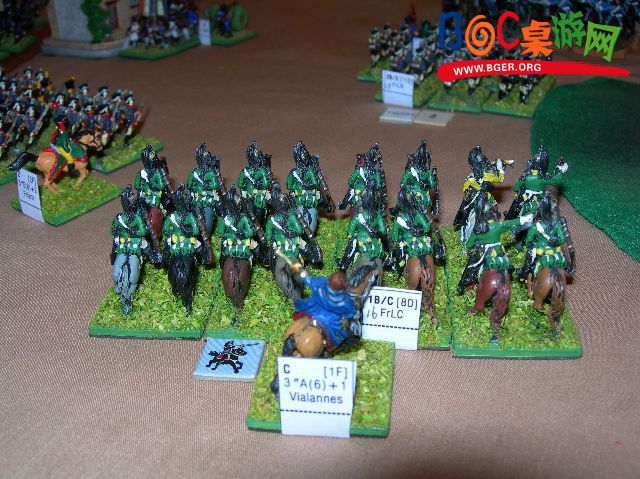
E.g. 3”G(6)+1
Command span (distance) = 3”
Quality level = Good
Response number = 6
Combat modifier = +1
Rally rout troops (1)
Rout troops must have general touching its base to attempt rally.
Die roll equal to or less than combat unit’s response number to successfully rally. Successful rally, become disorder, can change formation & facing.
Modifiers: General Quality level : Excellent +2, Good +1, Poor -1
Command control (1)
Overall commander: always in command
Wing Commander : In command if within command span of Overall commander.
Corp Commander : In command if within command span of Overall commander or a Wing commander who is himself in command
Division commander: In command if within command span of his Corp. commander who is himself in command
Combat unit: In command if within command span of his Div. Commander who is himself in command or with any general (in chain of command) touching its base.
Command control (2)
Commander without command: roll for initiative (equal or less than response rating)
Effect of successful initiative:
Inf, heavy artillery: half move; otherwise, no move
Cav, horse artillery: full move; otherwise, half move
Command Span becomes zero if the general is touching any combat unit
Movement (1)
Refer to Information Chart
Movement Allowance:
COL (Column)
LIM (Limbered artillery)
LIN (Line)
ULM (Man handling unlimbered artillery)
MCH COL (March column)
Movement cost:
RGH (Rough), SQ (Square) e.g. 2/1= Each inch movement expends 2 inches movement allowance.
Movement (2)
BCK (Backward), SID (Sideway) e.g. 2/1= Each inch of backward or sideway movement expends 2 inches movement allowance.
CG FM (Change formation) e.g. 2” = change formation from column to line reduce movement by 2 inches. Use the LIM/ULM movement allowance.
Cannot change formation if within 1” of enemy combat unit.
Road column can only change to column first, taking a complete turn.
Can freely move over/interpenetrate other friendly combat unit without penalty.
Cavalry Reaction Movement
Cavalry in command and do not move during movement phase can place reaction marker.
Instead of moving during the movement phase, these cavalry can use cavalry reaction movement.
Cavalry reaction marker is lost when contacted by enemy.
Line of Sight
Line of sight is blocked by:
Friendly combat units (including artillery),
Enemy Infantry or Cavalry (excluding artillery),
Town
Artillery dead zone: extends from base of a hill for a distance equal to the distance from the firing artillery to thebase of the hill.
Artillery may not be fired more than one inch into any wood.
Fire Principle (1)
Unit in combat contact may only fired at a target in its contact
In range (see information card & ranged artillery modifier chart) e.g.: 6lb 13”, 12lb 16”
Within firing arc (use infantry fire template & artillery fire template)
With line of sight (nothing closer than target for artillery, nothing on the same side of the Template’s center line for infantry)
Not disordered
Not in road column
The same fire factor for both line and column formation.
Fire Principle (2)
Both player roll a D10 and applies modifiers. (min = 0, max =10 after modifiers)
1 hit if modified firing number only exceeds the target number
2 hit if modified firing number is twice the target number
Unlimbered artillery as target: 1 hit if modified firing number is twice the target number.
Key modifiers: Firing unit‘s fire modifier, -2 Versus cover, +2 versus square, -2 Firing unit not protected versus attacking cavalry, +1 firing unit has 6-7 bases, -1 firing unit has 2-3 bases, +2 horse arty move and fire, +3 foot arty move and fire
Melee Combat (1)
Both player roll a D10 and applies modifier (min = 0, max = 10 after modifiers)
Difference = number of hits inflicted on loser, max loss for user = its rout number
If tie, 0 losses to both side if cumulative modifiers are negative
If tie, 2 losses to both side if cumulative modifiers from +2 to +4
If tie, 3 losses to both side if cumulative modifiers are +5 or more
If tie, 1 loss to both side in other cases
Melee Combat (2)
Modifying unit must be the unit with the highest number of bases who is also the unit to take all losses and must advance after combat.
Key modifiers:
modifying unit (refer to information card), different factor for line/column
attached general’s combat modifiers
-3 if disordered
+1 per 100% numerical (in bases) advantage, eg. 2 to 1 +1, 3 to 1 +2
Melee Combat (3)
Combat winner loss: If at least an enemy combat unit is dispersed, eliminated, routed, the modifying unit must take one hit for that whole combat.
Disordered unit must attempt to withdraw, both sides roll a D10, modified by attached general, response number, -3 for disordered. (min = 0, max =10), difference = no. of hit, only withdrawing unit takes hit.
Otherwise, fight another round of combat until dispersed, eliminated, routed or voluntary withdrawal.
Melee Combat (4)
Unless “VS OT” modifier applies, the “COL or LIM” modifier for column or limbered formation.
Unless “VS OT” modifier applies, the “LIN or ULM” modifier for line or unlimbered formation.
“SQ VS CV” for infantry in square which is ONLY in combat with enemy cavalry unit. I.e. “VS OT” modifier is used if infantry in square vs at least one enemy infantry unit.
For infantry not in square, “VS OT” is used if in combat with at least one cavalry unless in Town, woods, etc. or has at least one cavalry unit participating in combat.
Cavalry uses “VS OT” if in combat with enemy infantry or artillery not is in square, Town, woods, etc. ,presence of enemy cavalry in combat.
Cavalry Pursuit (1)
Cavalry become disordered and perform bounced movement if they are unable to rout or disperse enemy unit.
Disordered cavalry never use recall procedures
Victorious undisordered cavalry must use recall procedures.
Make the recall attempt: d10 equals or is less than the modified response number to recall successfully.
Modifiers: -1 Austrian heavy and light cavalry, -4 British (not KGL) cavalry units, -2 other cavalry units
If successful, do not become disorder and can move and contact another enemy unit or fall back.
If unsuccessful, become disorder and must attacke the closest enemy unit.
Cavalry Pursuit (2)
Enemy unit with react marker can move to contact a pursuiting cavalry who contact its friendly unit.
Any units can fire at a cavalry unit that just made a recall or reaction move.
Attaching Artillery with Combat Unit
Artillery can be attached to friendly infantry or cavalry unit by touching it.
All artillery attached to a unit which is routed by combat is routed as well.
Benefits: units attached to a infantry square unit are considered to be “sheltering in the square”.
Disorder
Become disorder if losses in a single phase reaches it disorder number.
Disorder number +1 if in town
cannot shoot
move at half speed
disorder unit it passes through
stop movement for one turn to remove disorder
Rout
Become rout if losses in a single phase reaches it rout number.
Rout number +1 if six or more bases.
cannot shoot
Initital rout movement: Infantry and unlimbered gunners move at 18“, Cavalry and limbered gunners move at 27”.
Subsequent rout movment: voluntary move as above, but lose one figure if moving.
Disorder unit it passes through
Successful rally becomes disordered unit.
Evasion movement
inactive cavalry and horse artillery not disorder or rout and not already in combat contact may use eavsion movement when enemy infantry unit moves towards combat contact.
Cavalry unit with react marker may use evasion movement when enemy cavalry moves towards combat contact.
Cavalry unit loses its react marker.
Unlimbered horse artillery change formation to limbered (without any cost) and use limbered movement allowance
Emergency Square
Unless infantry is already in square, must attempt to form emergency square if cavalry contact it.
Roll a d10, equal or less than modified response number to success.
Emergency square not possible if enemy already within 1“.
Unformed Movement
Just measure from any convenient spot on the unit and move the unit the desired distance from there.
Initial inch must be exactly straight back.
Unformed movment may move through gaps between units (friend and enemy). These gaps must be at least 2“ wide.
Movement is not halved by disorder or rout markers.
Unformed movement may never end within 1“ of enemy.
Types of unformed movement: Cavalry bounce movement, rout movement, withdrawal movement
|


 发表于 2010-8-16 16:44:50|

 收藏
 顶