屌丝版变体。。。
NEW VEHICLES AND RULES FOR FIREFIGHT
by
Alan R. Arvold
The following rules were formulated in the late 1970's and early
1980's and reflect the weapons, vehicles, and unit organiztions
of the period. They were never submitted to SPI. Here they are
for your viewing pleasure.
The following rules tie in with those in the article "More
Firefights" in Moves #30. They include some corrections to the
original article.
[30.0] Additional Vehicles
[30.22] (Addition) Vulnerability M551
Standard APC.
[30.71] (Addition) Maneuverability Chieftain
The Chieftain is allowed a maximum of three movement points when
using battlespeed.
[30.110] (Addition) PT-76
The PT-76 is a light amphibious tank that is used as a recon tank
by the Soviets. It has thin armor, average speed, and a 76mm gun
with a coaxle 7.62mm machine gun mounted in a turret.
[30.111] Maneuverability
Maneuverability is standard, three movement points. The PT-76 is
only allowed a maximum of four movement points when using
battlespeed.
[30.112] Vulnerability
Standard APC.
[30.113] Gunnery
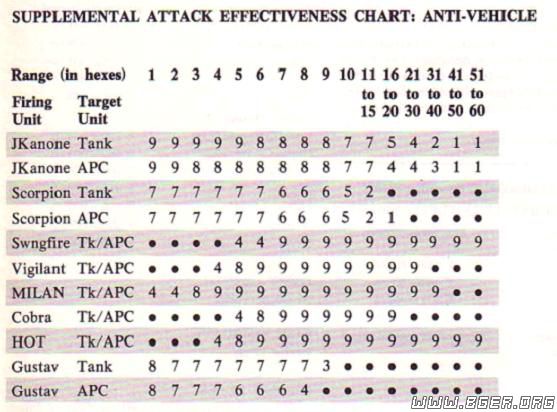
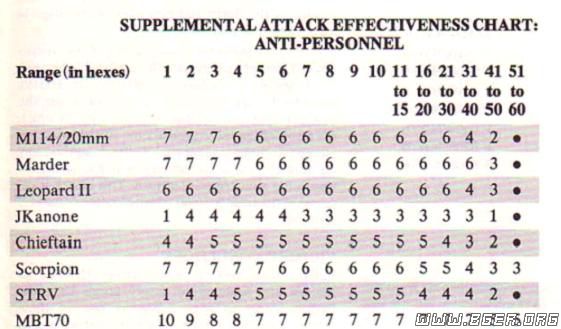
Uses the same Attack Effectiveness Charts as those of the BMP in
the Game. Does not carry an ATGM though.
[30.120] (Addition) BRDM-2 (BTR-40PB)
The BRDM-2 is an armored car that is used as a recon vehicle by
the Soviets. It is fast, is lightly armored, and carries a 14.5mm
cannon with a coaxle 7.62mm machine gun in a turret.
[30.121] Maneuverability
Movement allowance is six movement points. (Note: BRDMs are now
considered to have six movement points.)
[30.122] Vulnerability
Standard APC.
[30.123] Gunnery
Uses the Attack Effectiveness Chart for the MG+ team.
[30.130] (Addition) ASU-85
The ASU-85 is a light weight turretless assault gun used by the
Soviet airborne forces. It has thin armor, average speed, and an
85mm gun mounted in the hull with a coaxle 7.62mm machine gun.
[30.131] Maneuverability
Maneuverability is standard, three movement points. The ASU-85 is
only allowed a maximum of four movement points when using
battlespeed.
[30.132] Vulnerability
Standard APC.
[30.133] Fixed Firing Restrictions
Has the same firing restrictions as the Jagdkanone, see [30.63].
Also uses the same Attack Effectiveness Charts as the Jagdkanone.
[30.140] (Addition) BMD
The BMD is a smaller version of the BMP and is used by the Soviet
airborne forces. It has the same weapons and capabilities as the
BMP with a few differences.
[30.141] Maneuverability
Maneuverability is standard, three movement points.
[30.142] Vulnerability
Standard APC.
[30.143] Restrictions on use of BMD
A BMD carries a six man squad instead of the usual eight man
squad carried by the BMP. Mounted personnel units on the BMD may
only employ mounted fire from open hatches (like the M113). The
BMD uses the same anti-vehicular attack effectiveness charts as
the BMP. The BMD also uses the same anti-personnel attack
effectiveness charts as the BMP, however one is added to the
attack rating at all ranges (this reflects the two additional
7.62mm machine guns mounted in the hull of the BMD).
[30.150] (Addition) ZSU-23-4
The ZSU-23-4 is a self propelled anti-aircraft vehicle which has
four 23mm cannons mounted in a turret. It has a secondary role of
supplying direct fire against personnel and light-armored
vehicular targets.
[30.151] Maneuverability
Maneuverability is standard, three movement points.
[30.152] Vulnerability
Standard APC.
[30.153] Gunnery Restrictions
The ZSU-23-4 uses the MICV line in the anti-personnel chart and
uses the MICV line in the anti-vehicular chart for APCs out to a
range of 20 hexes. For shooting at APCs at ranges of more than 20
hexes and for shooting at tanks at all ranges, use the anti
personnel strength from the anti-personnel line for the MICV and
treat the fire effects against said targets as detailed in
Section 24.0.
[30.160] (Addition) BTR-60PB
The BTR-60PB is an APC that is still used by the Soviets and the
rest of the Warsaw Pact. (The BMP is only in one of the motorized
rifle regiments of the motorized rifle divisions and is in all
motorized rifle units organic to the tank divisions.) It is a
wheeled vehicle with eight wheels, thin armor, and carries the
same armament as the BRDM-2 in a turret. It is fast and carries
14 men plus a crew of two.
[30.161] Maneuverability
Movement allowance is six movement points.
[30.162] Vulnerability
Standard APC.
[30.163] Restrictions on the use of the BTR-60PB
The BTR-60PB carries a standard eight man squad. The squad may
use mounted fire and mounted fire on the move in the same manner
as the BMP. The BTR-60PB uses the MG+ line for both
anti-personnel and anti-vehicular fire. It follows the same rules
for movement as the BMP.
[30.170] (Addition) Vulcan
The Vulcan is a self propelled air defence vehicle which consists
of a 20mm cannon mounted on an open turret on top of a M113 hull.
It has a secondary role of firing at personnel and light armored
vehicular targets.
[30.171] Maneuverability
Maneuverability is standard, three movement points.
[30.172] Vulnerability
Standard APC
[30.173] Gunnery Restrictions
The Vulcan has the same gunnery restrictions as those of the ZSU
-23-4 (30.153) and the same Attack Effectiveness Charts.
[30.180] (Addition) Fire on the Move
All vehicles listed in this section (except trucks) may use the
short halt technique as described in Section 17.0. The M114, BRDM
-2, ZSU-23-4, MBT-70, Leopard II, Marder, Chieftain, BTR-60PB,
and Vulcan may also use the fire on the move option as described
in Section 17.0. The BMD may employ fire on the move in the same
manner as BMPs as described in Section 27.5. The Marder may
employ mounted fire on the move.
[30.190] (Addition) Battlespeed
All track vehicles listed in this section may increase their
movement allowance to five movement points using battlespeed
technique described in Section 7.6 except certain vehicles listed
in this section have battlespeeds less than five. Trucks may
increase their speed to three movement points using battlespeed
and may still use the special road movement rate.
[30.200] (Addition) Vehicular Machine Guns
The following vehicles have a machine gun mounted on top of the
turret or hull and may use this machine gun in accordance with
Section 6.61. These vehicles are the M551, MBT-70, Leopard II,
Marder, Jagdkanone, and Chieftain.
The following rules tie in with those in the article "Firefight-
City" in Moves #53.
Firefight IV
[35.0] Night/Limited Visibility Combat (Revision)
Commentary:
Up until now the rules have applied to combat conditions during
the daylight hours. Now we include rules to reflect the combat
conditions during nighttime hours.
General Rule:
All of the rules of observation found in the previous sections
are used with the following exceptions. There are two kinds of
light conditions at night; moonlight and starlight/cloudly. In
moonlight conditions the maximum range of observation for units
are two hexes in clear terrain and one hex in woods, town, and
defilade. In starlight/cloudly conditions the maximum observation
range is one hex for all types of terrain. All units beyond the
above mentioned ranges in all types of terrain may be observed in
a special way. All units that are within the daylight observation
range as described in Section 11.0 still have to be identified as
either personnel or vehicle targets, but may not be turned face
up until they either come within the normal nighttime observation
ranges listed above, they fire, or they are illuminated. The
above rules apply to all units and reflect the problems of
observation when no forms of artificial light devices or night
vision devices are used.
Cases:
[35.1] Effects of Nighttime Visibility of the Game
The above rules only have to do with direct fire. Movement is not
affected except that battlespeed may not be used at night. Nor
are the indirect fire rules. When indirect fire is used at night,
targets that are outside the nighttime observation range but
within the daytime observation range (Section 11.0) may be
targeted for indirect fire. The normal procedure is used except
when determining the final target hex. The indirect fire
automatically scatters from the final target hex in the same
manner as indirect fire in Section 19.0 (Suppressive Fire).
Overruns are not effected at night and may be resolved in the
same manner as during the day. Wire guided missile units (Dragon,
TOW, Sagger, etc.) may not be fired at night unless the target is
illuminated or the firing unit has a night vision device. All
fireteams, MG teams, amd machine guns mounted on top to vehicles
fire at suppressed strength at night. All other sections of the
rules are not effected by night rules unless described
differently in the sus-sections listed below.
[35.2] Flares
Flares are pyrotechnic devices which are used to light up an area
of ground during times of darkness. Flares come in two different
types; ground flares and parachute flares. Any unit may use
flares. Flares light up an area which includes the hex of impact
or deployment and a certain radius of hexes around the center
hex. Any unit that is within the lighted area may be spotted as
if in daylight. All normal rules of observation apply though. Any
unit that fires at a target within the lighted area of a flare
subtracts one from its attack rating at all ranges. This is in
addition to any other deductions from the attack rating. This
only applies to direct fire, indirect fire attacks normally.
Units in the lighted area may be spotted for indirect fire as if
it is daylight (fire does not scatter automatically). Flares take
effect the instant they are set off and last until the beginning
of the same phase they were set off in the next Game turn. The
setting off of a flare does not prohibit the owning unit from
firing or moving in the same phase. Units may set off flares at
any time during the firing and movement phases. Units that are
outside the lighted radius created by flares must still be
spotted in accordance with the nighttime rules. Counters are
included for both ground and parachute flares to mark their
respective impact or deployment hexes.
[35.21] Ground Flares
Ground flares are flares that are set up on the ground or are
thrown like a grenade by the using unit. Ground flares that are
set up on the ground are set up before the start of the scenario.
They may be set up in any hex. These flares may be included in
minefields and blocks also. These flares are considered to be
hidden when set up and are recorded just like minefields. When
the flares are set off, a flare marker is placed in the
deployment hex. Ground flares are set off in two ways. First a
units must move into the hex where the flare is. Units from both
sides may set off flares in this manner. Any type of unit may set
off the flare. The second way is for a friendly unit that is
within two hexes of the hex where the flare is located to command
detonate it. When using this method the flare may be set off at
any time during the movement or firing phases. Flares may only be
set up to go off with either of the above methods, not both. In
either case when the flare goes off, it lights up the hex that it
is in and all hexes within three hexes of the center hex. Flares
that are placed in town or forest hexes only light up the hex
that they are in. Once a flare is placed in a hex it may not be
moved at all during the scenario. Units that have ground flares
may throw them like grenades, using the rules in Section 14.3. In
this case a flare marker is placed on the impact hex instead of a
smoke marker.
[35.22] Parachute Flares
Parachute flares are flares that are shot up into the sky and
light up a usually bigger area then the same size ground flare.
Any type of unit may employ parachute flares. Parachute flares
have a fixed range at which they may be fired. This means that
they may be shot into any hex that is the exact range away from
the hex where the firing unit is. They may not be shot into any
hex closer to or further away from that range. Flares may be shot
from and into any terrain hex. Parachute flare illuminate the
impact hex and all hexes within the illumination radius
regardless of what type of terrain is within the radius. American
units have two types of parachute flares. One is the white star
round for the M203 greande launcher. It has a range of 6 hexes
and it illuminates the impact hex and all hexes within a 2 hex
radius. The second type is a signal flare and is used by all
units. It has a range of 6 hexes and it illuminates the impact
hex and all hexes within a 4 hex radius. Russian units have on
type of parachute flare. It is an illuminating rocket cartridge
and it has a range of 10 hexes and it illuminates the impact hex
and all hexes within a 4 hex radius. When the flares are fired, a
flare marker is put into the impact
hex.
[35.23] Limitations of Flares
Units may only shoot, throw, or set off one flare per turn.
Flares may only be used once in a scenario, once set off they may
not be used again. Weather conditions may effect a unit's line of
sight into an illuminated area as listed in the weather section.
[35.3] Artillery Illumination Rounds (Starshells)
Artillery and mortar units may fire illumination rounds to light
up large areas of the mapboard. Illumination rounds are in
reality big parachute flares that illuminate a larger area for a
longer time. These rounds follow the same rules as flares with a
few exceptions. Illumination rounds may only be dropped during
the indirect fire phase. Indirect fire units which fire
illumination rounds may not fire regular HE rounds during the
same indirect fire phase. Indirect fire units use the same
procedures and rules to fire illumination rounds as they do
regular rounds, including the automatic scattering of the initial
rounds at night. If indirect fire units perform fire into area
already illuminated then the automatic scatter is voided. An
illumination which is fired during a turn will burn out at the
beginning of the indirect fire phase of some future turn. Some
indirect fire units have illumination rounds which burn for more
than one turn. This means that an illumination round may light an
area for multiple turns (Example: An illumination round that
burns for three turns lands on an impact hex during the indirect
fire phase of turn 3. These round burns out at the beginning of
the indirect fire phase of turn 6.) Artillery units are not
required to stay assigned to firing starshells, especially those
that burn for multiple turns. Markers are supplied to represent
the impact hex of illumination rounds. Illumination rounds are
exempt from the rule that indirect fire requires that the impact
hex be spotted.
[35.31] American Illumination Rounds
The Americans have the following illumination rounds. First is
the 81mm Mortar round. It burns for 1 turn and has an
illumination area of the impact hex and all hexes within a 12 hex
radius. The second round is the 4.2 in. Mortar round. It burns
for 2 turns and has an illumination area of the impact hex and
all hexes within a 15 hex radius. The third round is the 105mm
Artillery round. It burns for 2 turns and has an illumination
area of the impact hex and all hexes within a 10 hex radius. The
fourth round is the 155mm Artillery round. It burns for 4 turns
and has an illumination area of the impact hex and all hexes with
a 20 hex radius.
[35.32] Soviet Illumination Rounds
The Soviets have the following illuminations rounds. First is the
82mm Mortar round. It burns for 1 turn and has an illumination
area of the impact hex and all hexes within a 5 hex radius. The
second round is the 120mm Mortar round. It burns for 1 turn and
has an illumination area of the impact hex and all hexes within a
12 hex radius. The third round is the 122mm Artillery round. It
burns for 1 turn and has an illumination area of the impact hex
and all hexes within a 10 hex radius. The fourth round is the
152mm Artillery round. It burns of 2 turns and has an
illumination area of the impact hex and all hexes within a 15 hex
radius.
[35.33] Limitations of Illumination Rounds
Illumination rounds effect combat in the game the same way as
flares do. All direct fire attacks in areas illuminated by
starshells have one subtracted from the attack ratings of each
attack.
[35.4] Night Vision Devices
Night Vision Devices are devices used to see out further into the
dark then what can be seen with the naked eye. There are three
basic types of night sights; search lights, starlight scopes, and
infrared lights. These will each be explored in separate sub
sections. Units and vehicles equiped with these devices have the
ability to spot units in the dark out to the range covered by the
device and to fire at targets out to those ranges. Units using
some of these devices also have the chance of being spotted and
found themselves. Flares and illumination rounds can also blank
out some of these deviced, making them temporarily unusable.
[35.41] Searchlights
Searchlight are unusually big lights (usually Xenon) that project
a visible beam of light to illuminate a target. These
searchlights are mounted on big vehicles such as tanks. A vehicle
equipped with such a light may illuminate any unit it can see and
fire at the target at no loss of points to its attack ratings.
Other friendly units may also fire at targets so illuminated with
no loss to their attack ratings. However the vehicle that is
using the light is automatically spotted by any enemy units that
have normal Line of Sight/Line of Fire to it. Enemy units may
fire at a friendly vehicle using its searchlight with only a
minus one on all of their attack ratings. A vehicle may only
illuminate one target unit per turn with its searchlight. If
there are several units in the target hex, the player
illuminating them must designate which one he is illuminating.
Normal daylight sighting procedures still apply when spotting
units illuminated by searhlights. The US player only has one type
of searchlight which is mounted on vehicles of the 300 series of
vehicles and the Sheridan. It has a range of 30 hexes. The
Soviets have two types of of searchlights. One of them is mounted
on all vehicles of the 300 series of vehicles and one the ASU-85.
It has a range of 30 hexes. The second type is mounted on all
vehicles of the 400 and 500 series of vehicles except the ASU 85.
It has a range of 20 hexes. If a vehicle is suppressed by small
arms fire, it is assumed to have lost its searchlight capability.
[35.42] Infrared Equipment
Infrared equipment is used on all vehicles and on certain weapons
that are hand carried or ground mounted. Infrared equipment
illuminating procedures are the same as those for the
searchlights with the following exceptions. When a target is
illuminated by infrared radiation it can only be seen by units
that are equipped with either infrared or starlight vision
devices. When firing at a target when using infrared lighting an
attacking unit must subtract one from its attack ratings at all
ranges. Infrared lighting may not be used when either the target
unit or the firing unit is in an area of illumination by flare,
starshell, or searchlight. The US has one type of infrared light
equipment. It is mounted on all vehicles of the 300 series of
vehicles and on the Sheridan. It has a range of 20 hexes. The
Soviets have three types of infrared equipment. The first type is
mounted on all vehicles of the 300 series of counters and on the
ASU-85. It has a range of 16 hexes. The second type is mounted on
all vehicles of the 400 and 500 series of counters except for the
ASU-85. It has a range of 10 hexes. The third type is a small one
that can be mounted on rifles, machine guns, SPG-9s and the SVD
sniper's rifle (where it is an organic part of the SVD). It has a
range of 8 hexes. Units equipped with infrared equipment can not
be spotted when using them except by other units with either
infrared or starlight equipment. When a vehicle with infrared
equipment is suppressed the infrared equipment is considered to
be destroyed.
[35.43] Starlight Equipment
Starlight equipment is used on small arms and light anti-tank
weapons. Starlight equipment sighting procedures are the same as
those for the searchlight with the following exceptions. A
starlight device does not illuminate a target unit. Instead it
picks up the ambient light reflected off any objects in the dark.
Therefore its range varies as the light conditions vary.
Starlight equipment can not be spotted by any form of night
vision equipment. The US has three types of starlight scopes. The
first type is used on rifles, machine guns, and the LAW. It has a
range of 8 hexes in starlight/cloudy conditions and 12 hexes in
moonlight conditions. The second type is used on vehicle mounted
machine guns and cannons (though not on tanks). It has a range of
20 hexes in starlight/cloudy conditions and 24 hexes in moonlight
conditions. The third type of starlight equipment is mounted on a
tripod all by itself. It has a range of 24 hexes in
starlight/cloudy conditions and 40 hexes in moonlight conditions.
Note that this weapon may not be used with any weapon to improve
its attack rating. The Soviets have one type of starlight scope
which is mounted on the RPG-7. It has a range of 6 hexes in
starlight/cloudy conditions and 8 hexes in moonlight conditions.
Vehicles which have a starlight scope mounted on one of its
weapons is considered to have lost its starlight scope when it
suffers a suppression result.
[35.5] Advanced Vehicles
Advanced vehicles such as the XM1, the MICV, the M113Z, and the
XBMT are considered to be equipped with the next generation of
night vision equipment. These devices use thermal imaging to
detect objects by picking up the ambient heat of the target
units. These devices have a range of 50 hexes. These devices can
not be spotted by other night vision device when in use. The
attack ratings of the weapons on these vehicles still have one
subtracted from their attack ratings at all ranges when using
these devices. These vehicles do not carry any other form of
night vision device. These vehicles do not lose their night
vision capability when they suffer a suppression result. (The
devices are protected by armor.)
[36.0] Soviet SP Guns
[36.5] (Addition)
The SP74 carries both a searchlight and an infrared night vision
device. These both have a range of 20 hexes. The on the board
SP74s may not fire illuminating rounds. The SP74 may increase its
speed to five movement points using battlespeed. The SP74 may not
use the short halt technique nor may it fire on the move when
firing its main gun. The SP74 may produce a smokescreen on the
move, does carry smoke round for its main gun, and does have
smoke grenades. The SP74 does have a 7.62mm machine gun mounted
on top of its turret.
[37.0] Weather and Enviromental Conditions
Commentary:
In all scenarios it is assumed that perfect weather exists all
the time. However for Germany this is not true. More than half
the time, in some or most parts of Germany there is adverse
weather or enviromental conditions which effect military
operations. The following rules simulate the different aspects of
adverse weather and enviromental conditions that are normally
encountered.
General Rule:
Weather generally effects the visibility on the the battlefield
in the forms of rain, fog, and falling snow. Enviromental
conditions (which include the effects of weather and the season
of the year) effect the mobility of units on the battlefield in
the forms of mud, deep ground snow, and hard frost. Each of these
will be explained in its own sub-section below.
Cases:
[37.1] Visibility
As stated before rain, fog, and falling snow effect visibility.
In general they reduce the distance which any unit may trace Line
of Sight/Line of Fire. This distance reflects the range which
units can see the enemy units and fire at them. The maximum
observable range in determined before the beginning of the
scenario and does not change for the whole game. (The real life
time which an average scenario depicts is about 12 to 15 minutes
and weather does not change that fast in Germany.) Units that are
within the new maximum observable range can be spotted and fire
upon in accordance with the rules. Units outside of this range
can not be spotted and fired upon. There is no decrease in the
attack ratings of any unit that fires at targets within the
observable range.
[37.11] Fog
At the beginning of the scenario roll one die and multiply the
resulting number by five. The final number is the maximum number
of hexes both players may observe out to during the course of the
scenario. This simulates the varied thickness of fog that occurs
at different times of the day. Fog usually occurs in the mornings
and burns off by midday. Fog can occur anytime of year.
[37.12] Rain and Falling Snow
At the beginning of the scenario roll one die and multiply the
resulting number by ten. The final number is the maximum number
of hexes both players may observe out to during the course of a
scenario. This simulates the varied intensity of both rain and
snowfall. Both may occur at anytime day or night. Rain may occur
any time of year while snow may occur only during the winter.
[37.13] Elevation and Observation
A unit's relative height has no bearing on the maximum range of
observation (i.e. he can't see over the fog). The maximum range
of observation in the same no matter what height the unit is at
in all forms of adverse weather. Observation of all types of fire
may not exceed the weather altered observation range.
[37.2] Mobility
As stated before mud, deep snow, and hard frost effect the
mobility of units. In general they increase the movement point
costs to enter certain terrain hexes. This applies to all
vehicles and in certain cases, personnel units as well.
[37.21] Mud
If the enviromental condition is determined to be that of mud the
following changes occur. The movement point cost into a clear
terrain hex is two movement points. Trails are considered to be
ineffective, they no longer negate the surrounding terrain of the
hex they are in. All other rules for movement still apply. Mud
generally occurs in the spring and the autumn of the year.
[37.22] Deep Snow
If the enviromental condition is determined to be that of deep
snow the following changes occur. The movement point costs into
clear and forest terrain hexes is three movement points. The
movement point cost for traveling along a road is one movement
point per hex. The road still negates the surrounding terrain in
the hex. Trails are considered to be ineffective, they no longer
negate the surrounding terrain of the hex they are in. It still
costs personnel units one movement point to move into any hex but
they may not use battlespeed movement. All other rules for
movement still apply. Deep snow usually occurs during winter.
[37.23] Hard Frost
If the enviromental condition is considered to be that of a hard
frost the following changes occur. All stream hexsides are
considered to be frozen over enoungh to allow light vehicles to
pass over them without the usual additional movement point cost
that is usually applied. Therefore the following vehciles may
take advantage of this rule. The M113, M114, M150, M113Z, Vulcan,
BMP, BMD, BRDM, BRDM-2, BTR-60PB, PT-76, ASU-85, Jagdkanone,
Scorpion, and the Truck. All other vehicles are considered to be
too heavy for the ice to support and must pay the one movement
point cost to cross the stream hexside. Hard frost generally
occurs during the winter.
[37.3] Integration
Different forms of weather and enviromental conditions may be
combined. For example a scenario occuring during the autumn may
have either rain or mud or may have both of them together.
However you may only have one type of weather effecting
visibility during a scenario. You may have more then one
enviromental condition affecting the scenario (this would be deep
snow and hard frost during the winter time).
[38.0] Riding on Vehicles other than APCs
General Rule:
All personnel units may ride on vehicles of the 300 and 400
series of of vehicle counters. (Although the Russians still train
their troops in this technique, it is seldom used due to the
general availability of other types of troop transports. NATO
troops are not trained in this technique at all. However in war
the time may come when troops will have to readopt this technique
in response to a desparate situation.)
Procedure:
When riding on vehicles of the 300 and 400 series of counters
personnel units are considered to be riding on the outside of the
vehicle. While this technique may be used by all vehicles of the
300 series, only the following vehicles of the 400 series may use
it; ASU-85, Jagdkanone, and STRV. A vehicle may carry an
equivilent of a squad (10 men) of personnel. A vehicle may
operate normally when transporting personnel, except that the
vehicle may not use battle speed. When a vehicle is killed or
suppressed, the personnel on the vehicle share the same fate as
the vehicle. When personnel on the vehicle are killed or
suppressed, the vehicle is only suppressed. When personnel on the
vehicle are fired upon they are considered exposed as if they are
dismounted.
[38.1] Mounting and Dismounting
When mounting a personnel unit on a vehicle use the same
procedure as that for mounting an APC. When dismounting a
personnel unit from a vehicle the personnel unit "jumps" off the
vehicle into the hex. The vehicle only loses one movement point
in the process and may continue moving if it has any remaining
after the personnel unit dismounts. The personnel unit may not
move from the hex in the same turn it "jumps" into it.
[38.2] Mounted Fire and Overrun
Personnel units riding on a vehicle may use mounted fire as
described in Sections 16.0 and 17.0. When performing mounted
fire, all mounted personnel may participate, not just one
fireteam. When the vehicle is performing an overrun attack or is
being overrun, the mounted personnel do participate in the
overrun combat. At the player's option they may even dismount
from the vehicle before the resolution of the overrun combat. The
vehicle suffers no movement point loss in this case.
[39.0] Defilade
Commentary:
In the basic game defilade positions are usually found on hills
and ridges. This is understandable because units on hilltops and
ridges are using the slope of the ground by sitting on the
reverse side of the hill or ridge exposing only turrets or
missile launchers. However defilade can be found almost anywhere
on the map, one just has to look for it. Hence the following
rules are for vehicle units only.
General Rule:
Vehicle units may attempt to enter into defilade positions on any
hex of the map. To do so a vehicle unit must spend an entire turn
in a hex and roll one die at the end of the turn to determine if
it entered into defilade. A roll of 1 or 2 in clear terrain and a
roll of 1, 2, or 3 in forest and town hexes means that a defilade
marker may be put on top of the vehicle counter. This defilade
counter must be faced towards a specific hexside but the owning
player has the option of which direction. As noted in the
diagram, the front three hexsides of the defilade counter provide
defilade protection, the three rear hexsides do not. Vehicles may
enter into defilade in any type of hex. They may not enter into
defilade in the same hex as enemy units. Multiple vehicles are
treated separately when seeking defilade in the same hex. They
may position their respective defilade counters in the same or in
different directions at the owning players choice.
[39.1]
Defilade markers follow the same rules of defilade as the regular
defilade positions printed on the map. A unit may freely move out
of a defilade marker at no extra movement cost. As soon as the
unit leaves the hex the defilade marker is removed. This also
applies when a vehicle unit is killed while under a defilade
position. There is never any additional movement cost for a unit
(friendly or enemy) to enter a hex containing a vehicle under a
defilade counter. Vehicles may start a scenario with a defilade
counter already on them.
[39.2]
A player may attempt to change the facing of the defilade marker
under which he has a vehicle. To do so he must repeat the same
process as that to enter into defilade. Success means that the
marker's facing is changed, failure means that the vehicle loses
the defilade marker all together.
[40.0] Ammunition Supply
Commentary:
Up until now in all scenarios all weapon systems are assumed to
have an unlimited supply of ammunition. Given the actual
simulated time in the scenarios this is a reasonable assumption.
But there are some situations where one or both sides will have a
shortage of ammunition for all or some of their organic and
attached weapons. (This will most likely occur towards the end of
a long scenario.) Thus we present the basic loads of ammunition
that each unit carries for each of their weapons systems. Note
that this rule requires extensive bookkeeping by the players and
should only be used for small scenarios.
General Rule:
Each unit regardless whether it is vehicle or personnel is given
a basic load of ammunition for each weapon system it is carrying.
The number of rounds carried corresponds to the number of times
that weapons system may be fired in the course of the scenario. A
round may represent one actual round, missile, or rocket for guns
and missile systems or it may represent a sustained burst or fire
for small arms or automatic cannons. When a unit runs out of
rounds for a weapons system it may not fire it again for the
duration of the scenario. Every time a unit fires it uses a round
of ammunition. In certain situations a weapons system may be
fired more than once in a game turn, therefore more than one
round may be expended in a single game turn by the unit.
Cases:
[40.1] Soviet Units
The T-62, PT-76, ASU-85, and the BMP each carry 40 rounds of
ammunition for their guns. The XMBT carries 43 rounds for its
main gun. The BMD carries 30 rounds for its main gun. The
ZSU-23-4 and the SAU-122 each carry 20 rounds for their main gun.
The BTR-60PB, the BRDM-2, and all vehicles with a machine gun
mounted on top of the turret or hull each have 15 rounds. The BMP
carries 5 Sagger missiles, the BMD carries 4 Sagger missiles, and
the BRDM carries 14 Sagger missiles. The Dismounted Sagger unit
carries 4 Sagger missiles. The SPG-9 units carries 6 rounds.
Personnel units armed with an RPG-7 carry 8 rockets for it.
[40.2] American Units
The M60A1, M60A3, MBT-70, and the XM1 each carry 63 rounds of
ammunition for their main guns. The M60A2 carries 30 rounds for
its main gun. The M551 and Vulcan each carry 20 rounds for their
main gun. The MICV, M114, M113, M150, M113Z, and all vehicles
which have a machine gun mounted on top of the turret or hull
each carry 15 rounds for the main guns/machine guns. The M60A2
carries 12 Shillaleagh missiles. The M551 carries 8 Shillaleagh
missiles. The M150 and the M113Z each carry 10 TOW missiles.
Personnel units armed with a Dragon Missile are presumed to be
carrying 2 missiles. All personnel units carry one LAW per man in
each unit.
[40.3] Foreign Units
The Leopard II carries 60 rounds. The Chieftain carries 64
rounds. The STRV carries 50 rounds. The Jagkanone and the
Scorpion each carry 40 rounds. The Marder carries 15 rounds. All
vehicles which have a machine gun mounted on top of the turret or
hull each carry 15 rounds for the machine gun.
[40.4] Personnel Units
There is no limit to the amount of times which personnel units
may fire at other personnel units.
[40.5] Scenarios
Certain scenarios may have a limited amount of ammunition allowed
to one or both sides. The figures listed above are the maximum
amount allowed to each vehicle. Also dismounted personnel units
with anti-tank weapons which start the game in improved positions
are presumed to have an unlimited number of rounds for those anti
tank weapons systems as long as they stay in the improved
positions.
[41.0] Special US Ammunition
US tanks have two special rounds for use against personnel
targets in clear terrain. The first is the Canister round which
is like a big shotgun round. It is used against personnel targets
that are close up (out to 200 meters or 4 hexes). The second type
of special round is the Beehive round. This is a variation of the
Canister round where the round is set to explode at a certain
range from the gun after it is fired. When it explodes it does so
with the same effect as the Canister round.
[41.1]
When a tank fires a Canister round it projects a varied attack
rating according to the attached diagram. The numbers inside the
hexes on the diagram are the attack rating applied against all
personnel units in those hexes. The hex that the firing unit is
in has no attack rating. When a tank fires a Beehive round the
round may explode in any hex from a range of 4 hexes out to and
including 60 hexes which the firing unit has a direct line of
sight to. When the round explodes in the hex a Beehive marker is
placed on the impact hex. From there a pattern of attack ratings
is projected according to the attached diagram. The diagram
extends away from the impact hex along the line of sight from the
firing unit through the impact hex or as close to it as possible.
The pattern extends away from the firing unit, not towards it.
[41.2]
All exposed personnel units (both friendly and enemy) when caught
in the blast pattern of either round are attacked with the attack
rating corresponding to the hex they occupy within the pattern.
All vehicle units are forced to button up if they are within the
blast pattern of either round. Personnel units inside vehicles
which are caught within a blast pattern are not affected. The
blast pattern does not extend through forest and town hexes
although they would effect units in the first one of either type
of hex. Blast patterns may extend through contour lines in
accordance with the rules of Section 13.11. Neither Canister nor
Beehive rounds may be used in overrun situations.
[41.3]
Both Canister and Beehive rounds are rare and are always in
limited supply. It is suggested that the US player at the
beginning of scenario roll one die to determine the total number
of each type of round he has for his whole force. The resulting
number of rounds of each type may be divided up amoung the
various tanks in the US player's force.
[42.0] Command Control
Commentary:
Up until now command control has been assumed to be automatic
amoung both vehicle and personnel units. Now command control
largely depends on a special panic table for each side. Special
things are taken into account such as visibility, the location of
the leaders, and the general condition of the unit in question.
Note that this rule increases the game length substantially.
General:
Immediately before firing or moving any unit, the player must
check for command control (or panic) of the unit by checking the
Panic Table for the number range needed to be rolled in order to
bring on panic. This number range can be modified by the effects
of visibility, location of leaders, and other things. Two dice
are rolled and if the resulting number is the within the number
range for panic then the unit panics. Any other result means that
the unit operates normally. A panic marker is placed on a unit
when it panics during any phase of the game turn. Panic may be
removed from a unit during the suppression removal phase.
Cases:
[42.1] Panic Fire
A unit that panics while attempting to fire may neither fire nor
move in that Game Turn as it is in a state of panic-fire.
[42.11]
A unit that panics while attempting to fire and fails to remove
the panic marker during the Suppression Removal phase of that
game turn must continue doing nothing during all succeeding game
turns until the panic marker is removed.
[42.12]
Panic is determined for each individual unit that attempts to
fire each turn. Units involved in an overrun firefight may fire
regardless of whether they panic or not.
[42.2] Panic Movement
A unit that panics while attempting to move performs a panic
move. This condition is reflected by rolling the die and
consulting the scatter diagram on the map. The resulting
direction is the direction that a panicked unit moves. If the
unit is a dismounted personnel unit it moves one hex in the
indicated direction. If the unit is a vehicle the die is rolled
again, and the resulting number is the number of movement points
the unit may move in the indicated direction (subject to the
vehicle's normal movement allowance).
[42.21]
A unit that panics while attempting to move and fails to remove
the panic marker during the removal phase of that game turn must
continue to panic move on all succeeding game turns until the
panic marker is removed.
[42.22]
Panic is determined for each individual unit that attempt to move
each turn. Units may perform overruns as a result of a panic
move.
[42.3] Panic Table
Soviet attempting to move 1 or less
Soviet attempting to fire 4 or less
American attempting to move 1 or less
American attempting to fire 3 or less
Each time a unit attempts to move or fire it must undergo a panic
roll on the panic table using both dice. If the dice roll is
within the number range the unit panics. Note that normally with
two dice a player will not roll a one but the following modifiers
may reduce the final result to one or below. If the scenario is
happening at night or in times of limited visibility (rain,
falling snow, fog) two is subtracted from all panic check dice
rolls. If a unit is suppressed two is subtracted from the panic
check dice roll. If a unit can not trace a line of sight to
another friendly unit within the same platoon two is subtracted
from the panic dice roll. All of these modifiers are cumulative.
[42.4] Panic Removal Table
Soviet: 2 or less
American: 5 or less
One die is rolled when using the panic removal table. If the die
roll is within the number range on the table the unit recovers
from panic.
[42.5]
Units which start the game in an improved position do not have to
roll for panic until after the first time they fire, are fired
upon
in any manner, or they move out of improved position.
[43.0] Different Size Fireteams and New Squad and Platoon
Organizations
Commentary:
Different types of infantry have different types of squad and
platoon organizations within their respective armies. For
example, the American light infantry and mechanized infantry each
have their own organizations. The Soviet airborne and motorized
infantry each have their own organizations. Therefore we have
provided larger and smaller size fireteams, both with and without
machine guns, and the corresponding attack effectiveness ratings
against enemy personnel units for each type of fireteam for both
sides.
General Rule:
Fireteams now come in five different sizes. There is the one man,
two man, three man, four man, and the five man fireteams. Each
fireteam has a corresponding team with a machine gun with the
exception of the one man team. All fireteams are treated as
regular personnel units in all respects.
Cases:
[43.1] American Infantry
There are three types of infantry; mechanized, light, and
airborne/airmobile. Each will be described separately.
[43.11] Mechanized Infantry
Each squad consists of an APC, a carrier team, and a maneuver
team. The carrier team consists of the driver, the gunner for the
.50 cal machine gun, and the team leader, plus whoever else the
squad leader leaves with them. The maneuver team would consist of
the team leader and the rest of the squad not assigned to the
APC. The squad leader would be with either the carrier team or
the maneuver team. The number of men in each team is variable
according to the tactical situation, but a squad may never have
more than eleven men. Therefore the Amercian player may break up
his squad into as many teams as he wants to. The carrier team
must have at least two men (the driver and the machine
gunner/team leader who are the normal crew of the APC and
therefore do not get a fireteam counter for themselves) but may
have more men if the player so desires. Any extra men will be
given a fireteam counter equal to the number of men in the
fireteam plus a machine gun if they are assigned one. When there
are two men in the carrier team the team leader mans the machine
gun but when there are three or more men in the APC then the one
of the extra men becomes the machine gunner. The maneuver team
may have any number of men up to nine including the squad leader
(unless he stays on the APC), the team leader, and the rest of
the squad. These may operate as one fireteam or as two separate
fireteams subject to the number of men available and the size of
teams the player wants. When the maneuver team operates as two
smaller fireteams the squad leader is in one fireteam and the
team leader is in the other. There is a two man fireteam assigned
to the platoon headquarters APC in addition to the normal carrier
team. One is the assistant platoon sergeant and the other is an
extra man. The platoon leader normal acts as the machine gunner
on the APC but could have the assistant platoon sergeant perform
this task as well. There are five M-60 machine guns in a platoon.
Each squad has one and the other two are distributed amoung the
squads and the platoon leaders discretion. No squad may have more
than two machine guns. The two man fireteam on the platoon
headquarters APC may become an MG team if so desired.
[43.12] Light Infantry
Each squad consists of two five-man fireteams and a squad leader
which may have a single one man counter. The platoon consists of
three regular squads and a weapons squad of ten men. In a weapons
squad there are two M-60 machine gun and three Dragon systems.
The weapons squad may be broken up into as many teams as the
player wants keeping in mind the ten man limit, it may operate
together as a regular squad, it may be distributed amoung the
three regular squads, or any combination of the above. Dragons may
be transfered to a fireteam in a regular squad or it may operate
as a one man team. Once such a transference is made in a scenario
it is permanent.
[43.13] Airborne/Airmobile Infantry
Airborne/Airmobile infantry is organized and operated like light
infantry with two differences. The regular squads have ten men
instead of eleven in the light infantry so the squad leader is
in one of the fireteams. The weapons squad has nine men with two
M-60 machine gun and two Dragon systems assigned to them. Other
than those there are no other differences between light and
airborne/airmobile infantry.
[43.2] Soviet Infantry
There are two types of infantry; motorized and airborne infantry.
Each will described separately.
[43.21] Motorized Infantry
The squad and platoon organizations described in the rule book
apply to the motorized infantry.
[43.22] Airborne Infantry
Each squad consists of one BMD vehicle and a six man squad. The
squad may be broken down into two teams of any size as long as
the total number of men in both teams equal six. The squad has
one machine gun and one RPG-7. Other then the six man squad and
the special qualities of the BMD, Airborne Infantry is organized
and operates in the same manner and motorized infantry.
[43.3] Vehicle Crews
In certain tactical situations some vehicles may dismount some of
the crew and weapons systems. The M113, M150, and M113Z may
dismount the machine gun on top of the APC. With it comes one man
from the crew. In order to put it into operational status, one or
two men from a nearby personnel unit must be used depending on
how big you want to make the MG team. The M113Z and the M150 may
also dismount the TOW missile system and two men. The TOW uses
the same values in both mounted and dismounted configurations on
the attack effectiveness chart. In all of the above cases
mounting and dismounting follow the same rules as regular
personnel units. The dismounted teams may not move from the hex
they dismount into (the weapons systems are too heavy to move
tactically) but the vehicle may move. The BRDM may dismount a two
man team in a hex adjacent to the vehicle. The vehicle may not
move and the team is armed with an RPG-7. The T-62 may dismount
one man with a machine gun but a nearby personnel unit must
supply one or two men in order to make it an operational MG team.
The T-62 may not move and the MG team may not move either and
must be an adjacent hex to the T-62. In all cases these special
dismounted teams may fire on the anti-personnel attack
effectiveness chart and follow all other rules pertaining to
personnel units.
[43.4] Reconnaissance Units
Both the Americans and the Soviets have light reconnaissance
units, better known as scouts. For the Soviets consist of
riflemen mounted on motorcycles. For the Americans they consist
of scouts mounted on Jeeps. The Soviets have three types of recon
counters. Two of them are one man and two man fireteams mounted
on individual motorcycles. The othe counter is a two man MG team
mounted on one motorcycle with the machine gun mounted on a
sidecar. The Americans have only one type of counter. It is a
three man MG+ team mounted on a Jeep. All counters have a
movement factor of six movement points and are treated as
dismounted personnel targets in terms of vulnerability. These
units may not be mounted on any vehicle in the game. When
employing fire on the move these units may use both the short
halt technique and the fire on the move technique for machine
guns as described in Rule Section 17.13. The American units may
carry LAWs but the Soviets may not carry the RPG-7. The Soviets
are usually employed in sections of five motorcycles each
although it is possible that smaller groups of motorcycle scouts
may be found in reconnaissance teams. The American units are
usually employed in teams of two or four Scout Jeeps each. When
employing direct fire these units use the corresponding fireteam
or MG+ team line on the attack effectiveness chart in relation to
their size and compsition.
[43.5] Larger Scale Recon Units
Both sides have recon elements from their respective higher level
headquarters which may sometimes be on the forward edge of the
battlefield. They are either used in conjunction with other units
or they are used by themselves.
[43.51]
US Armored Cavalry Platoon: 6 M551, 2 M113, 2 TM+, 1 Dragon , 1
M106 (represented as 1/2 off map 4.2 in. Mortar).
This is the present organization of the armored cavalry platoons
in the Armored Cavalry Squadrons.
[43.52]
US Armored Cavalry Platoon: 3 M551, 4 M114, 2 M113, 2 TM+, 1
Dragon, 1 M106 (represented as 1/2 off map 4.2 in. Mortar).
This is the old organization of the armored cavalry platoons
which may still exist in some units which are still awaiting
conversion to the new organization.
[43.53]
US Reconnaissance Platoon: 4 M150, 6 M113, 4 MG, 4 Dragon
(Divided up one per MG team).
This is the present organization of the reconnaissance platoons
organic to the armored and mechanized infantry battalions.
[43.54]
US Reconnaissance Platoon: 12 M114
This is the old organization of the reconnaissance platoons which
may still exist in some units which are awaiting conversion to
the new organization.
[43.55]
Soviet Reconnaissance Platoon: 3 PT-76, 4 BRDM-2.
This is the standard reconnaissance platoon organic to the tank
and the motorized rifle regiments.
[43.6] Engineers
Engineer units are regular personnel units who in addition to
following all the rules pertaining to personnel units also have
engineer capabilities. In a game of this tactical level this
translates into the ability to breach obstacles. Engineer units
come in fireteam counters just as the other personnel units do.
In order to breach minefields and blocks an engineer unit must be
adjacent to which the obstacle is implaced. The unit remains
adjacent for six turns performing no functions. Starting on the
seventh turn the owning player rolls the dice in the direct fire
phase, using the following table to determine the success of
breaching the obstacle. If the number rolled corresponds to the
number on the chart for that turn, the obstacle is breached.
Turn 7 - 2
Turn 8 - 2, 12
Turn 9 - 2, 3, 12
Turn 10 - 2, 3, 11, 12
Turn 11 - 2, 3, 4, 11, 12
Turn 12 - 2, 3, 4, 10, 11, 12
Turn 13 - 2, 3, 4, 5, 10, 11, 12
Turn 14 - 2, 3, 4, 5, 9, 10, 11, 12
Turn 15 - 2, 3, 4, 5, 6, 9, 10, 11, 12
Turn 16 - 2, 3, 4, 5, 6, 8, 9, 10, 11, 12
Turn 17 - Automatic Breach of Obstacle.
An engineer unit must stop the breaching process whenever it is
suppressed, but once suppression is lifted the process may
continue from where it was interupted. If the engineer unit is
killed during the process, another engineer unit may come and
continue the process starting where the previous engineer unit
left off. It takes at least a two man engineer team to perform
the process. When the obstacle is breached the marker is removed
from the board. American engineer squads are organized in the
same way as their infantry counterparts except that they do not
carry an M-60 machine gun in their squad. Russian engineer squads
follow the rules as their infantry counterpart except that they
always ride in a truck instead of an APC. |


 发表于 2012-4-29 13:58:57|

 收藏
 顶